Description
Origami is one of those things we all think we know what there is to know about it. Boy, were we wrong! When we started looking into it, there was so much more than imagined. Come with us as we travel in time back to the Edo period in Japan from 1603 to 1868. There are some things about that time that you’ll want to know.
Emperors ruled Japan during that time, but they had little real power. The power was in the hands of the Shoguns and under them, the Samurai… Samurai would never consider working on a farm like a peasant or in a business like a merchant. It was, however, considered proper for them to give their time to the arts and literature.
The Closed Country Edict of 1630 prohibited Japanese from traveling outside the borders of Japan and forbade anyone who did leave from ever being allowed to return. Much of the art we think of as Japanese was created during the Edo period.
Almost everyone has seen at least one painting by Hokusai (1760-1849). His The Great Wave off Kanagawa or his Fine Wind, Clear Morning, both paintings in his Thirty-Six Views of Mount Fuji series are so iconic you probably recognize them… many artists collected his work, such as Degas and Van Gogh, and others show clear influence by it, including Monet and Renoir.
Hokusai strongly influenced one of Japan’s most famous painters of this period, Hiroshige (1797-1858), the last great master of the ukiyo-e painting that we so closely associate with Japan. He produced over 8000 works and influenced art in Russia, Europe, and the United States. Van Gogh did his own studies of several of his works. Manet and Monet collected his paintings and Cezanne and Whistler were influenced by his work.
The Edo period also saw the growth of origami, or folding paper into works of art into a widely enjoyed pastime in Japan. Originally, orikata as it was then called was used exclusively for ceremonial purposes. During the Edo period, paper began to be mass-produced (and therefore much more affordable). The directions in the few other guides published in the 1800s were very difficult to understand. You almost had to know how to do it already to follow them!
In the 1930s, Akira Yoshizawa developed a set of symbols to explain how to fold paper in origami. His system caught the eye of Samuel Randlett, who extended it in his Art of Origami in 1961. These symbols made it easier for ordinary people to duplicated complicated origami models. Since then, many people have come to enjoy origami, from young children using the simplest forms to well-known artists creating puzzles and abstract art from folded paper.
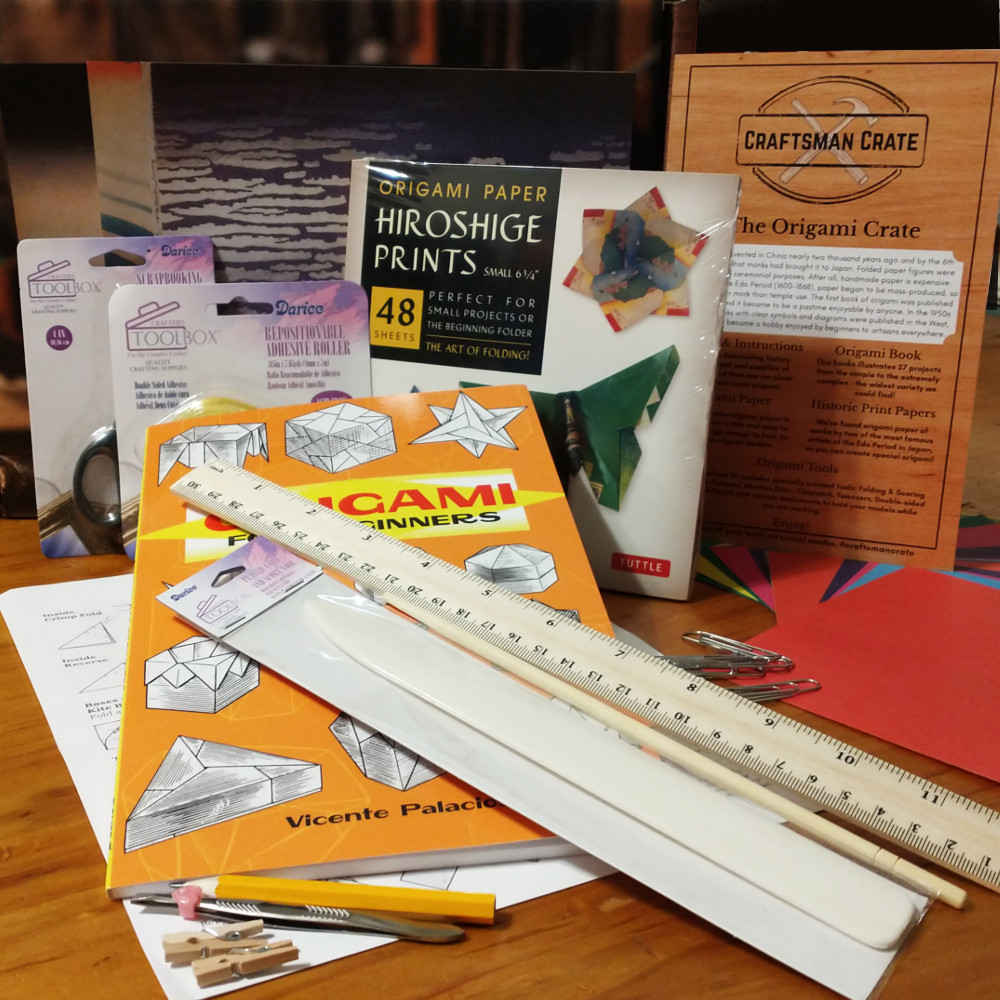
The Origami Crate Contains:
Instructions and Patterns
Birds in Origami – This book is by John Montroll, a former math teacher, well-known origami artist, and prominent author of origami books. Montroll began doing origami at the age of 6! We’ll be teaching the symbols you need to know in a handy-dandy reference page you can keep beside you as you work!
Folding Bone – This hard tool makes it far easier to appropriately fold and crease paper. We chose one that can also score paper to make it easier to fold an awkward fold, giving you two tools in one.
Wood Ruler – For measuring distances to fold and for measuring paper strips or squares.
Micro-Scissors – These allow you to make tiny snips and cuts wherever you need them.
Small and Large Paper Clips – When you wish you had three or four hands because you need to hold a fold closed, use these, but be careful not to push them too far on where they might mark the paper.
Mini-Clothespin – Use this when you need to hold a fold ever-so-gently. Be careful, though. These are very fragile and easily broken.
Washi Tape – This is the easiest way to stick together two sheets of paper when you need to.
Chopstick – The traditional tool for poking out folds and corners.
Tweezers – When the chopstick just isn’t enough and you need to grab a tiny edge.
Tye-dyed Origami Paper – We suggest you start with this paper. It’s easier to see your folds and lines on paper without a pattern. Like all our paper, this is high-quality paper made especially for origami by a Japanese-American art and publishing house.
New in 2025: Ukiyo-e Bird Print Origami Paper – This large paper is printed with paintings of birds in the ukiyo-e style of the Edo period. Larger paper is easier to fold, so this is a great place to start once you are done practicing.
Hokusai Prints Origami Paper – This is a good next step, once you’ve developed some skill. We’ve given you several sheets of 8 inch square paper with prints by the famous Hokusai (if you don’t know why that’s really cool, go back and read the introduction like you were supposed to!). They are larger than normal, which makes folding easier, which should help with the challenge of folding a paper with a design for the first time.
Hiroshige Prints Origami Paper – These are incredibly interesting once folded into origami art. The complexity of the paintings, when folded into origami, add an entirely new dimension to the art. Japanese artists speak of having to get up their courage to begin to fold it because it means so much to handle the paintings of a master like Hiroshige. Yet, it is highly appropriate to use prints of the Edo period as origami paper. We think you’ll be stunned by how attractively it turns out.
Enjoy!
Subscribe to Craftsman Crate to have one of these amazing crates delivered to your house every month complete with the tools, supplies, and lessons to learn the skills of an artisan! Use Craftsman Crate as a gift, a hobby, or a curriculum – it’s fun, it’s rewarding, and it’s authentic. Click to learn more!


Reviews
There are no reviews yet.